
Views: 0 Author: Site Editor Publish Time: 2026-07-16 Origin: Site


Precision glass fabrication operates on razor-thin margins for error. Micro-fractures, edge chipping, and dimensional inaccuracies directly erode profitability on the shop floor. Scaling production for complex glass components—such as architectural cutouts, appliance panels, or optical parts—often creates severe bottlenecks when relying on legacy equipment or multi-step manual processing. Moving glass between different stations increases handling risks and slows down throughput. Upgrading to an automatic glass milling machine consolidates drilling, routing, and edging into a single CNC-controlled setup. This eliminates redundant handling and ensures exact dimensional accuracy across large batches. This guide evaluates the exact processing capabilities, material tolerances, and operational trade-offs to determine if an automated milling center aligns with your production requirements. We will look at tooling mechanics, material limits, and facility needs to help you make an informed equipment decision.
Versatile Processing: Modern automated systems handle everything from internal cutouts and countersinking to edge profiling, surface pocketing, and delicate mirror fabrication without repositioning the workpiece.
Material Breadth: Beyond standard float glass, specialized equipment like a glass and slab milling machine can process thick architectural glass, quartz, borosilicate, mirrors, and hybrid stone slabs.
Automation ROI: The shift from a manual glass milling machine to an automatic system reduces operator dependency, minimizes handling-induced defect rates, and guarantees high-volume repeatability.
Implementation Realities: Successful deployment requires rigorous evaluation of spindle specifications, tooling costs (diamond bits), clamping mechanisms (vacuum suction), and facility infrastructure (coolant and filtration systems).
A glass milling machine executes complex internal geometries using interpolating CNC axes. You can program sink cutouts, hinge notches, and appliance panel openings directly into the control software. The machine uses continuous tool paths to prevent stress concentrations at corners. Sharp internal corners in glass are notorious starting points for cracks. By programming a slight radius and maintaining a constant feed rate, the milling bit distributes the cutting force evenly. This continuous motion ensures structural integrity, especially for panels that will later undergo tempering or bear structural loads.
Understanding the physical forces at play helps optimize tool life and edge quality. Drilling involves axial forces. The core drill plunges vertically into the glass, pushing material downward. CNC milling relies on radial forces. The router bit moves laterally, cutting with its side profile. Milling machines perform helical interpolation to create holes of varying diameters with a single tool. The spindle moves in a descending circular path. This eliminates the need to swap multiple drill bits for different hole sizes. It also allows for precise countersinks, ensuring flush hardware mounting for hinges and standoffs.
Process | Force Direction | Tooling Used | Primary Application |
|---|---|---|---|
Plunge Drilling | Axial (Vertical) | Diamond Core Drill | Fixed-diameter holes, fast cycle times. |
Helical Milling | Radial (Lateral) + Axial | Diamond Router Bit | Variable hole sizes, internal cutouts, countersinks. |
Edge Profiling | Radial (Lateral) | Trapezoidal/Profile Wheels | Shaping and polishing external glass edges. |
You can create flat, pencil, or complex stepped edges directly on the milling bed using specialized diamond profile wheels. The machine automatically swaps tools from the magazine. It starts with a coarse grit metal-bonded wheel for rapid stock removal. Then, it transitions to finer resin-bonded wheels for smoothing. Finally, a polishing wheel brings the edge to a high optical clarity. This transition from rough milling to high-polish finishing occurs within the same machine cycle. You do not need to move the glass to a separate straight-line edger, saving significant floor time and reducing handling damage.
These machines perform shallow surface removal with high precision. You can program recessed pockets for structural fittings, allowing metal brackets to sit flush with the glass surface. Decorative V-groove engraving on glass plates and mirrors is also standard. The Z-axis control must be exceptionally rigid to maintain a consistent depth across a large glass sheet. Even a fraction of a millimeter variance will show up as an uneven groove or a pocket that binds against the hardware.
Processing silver-backed mirrors and low-emissivity (Low-E) glass presents unique challenges on the shop floor. The silver backing is prone to flaking, and Low-E coatings scratch easily. Advanced milling paths prevent backing delamination. The software adjusts the entry angle and feed rate to minimize upward pull on the coating. Copious amounts of clean, filtered coolant prevent silvering oxidation and wash away abrasive glass swarf before it can scratch the delicate top surface during the machining cycle.
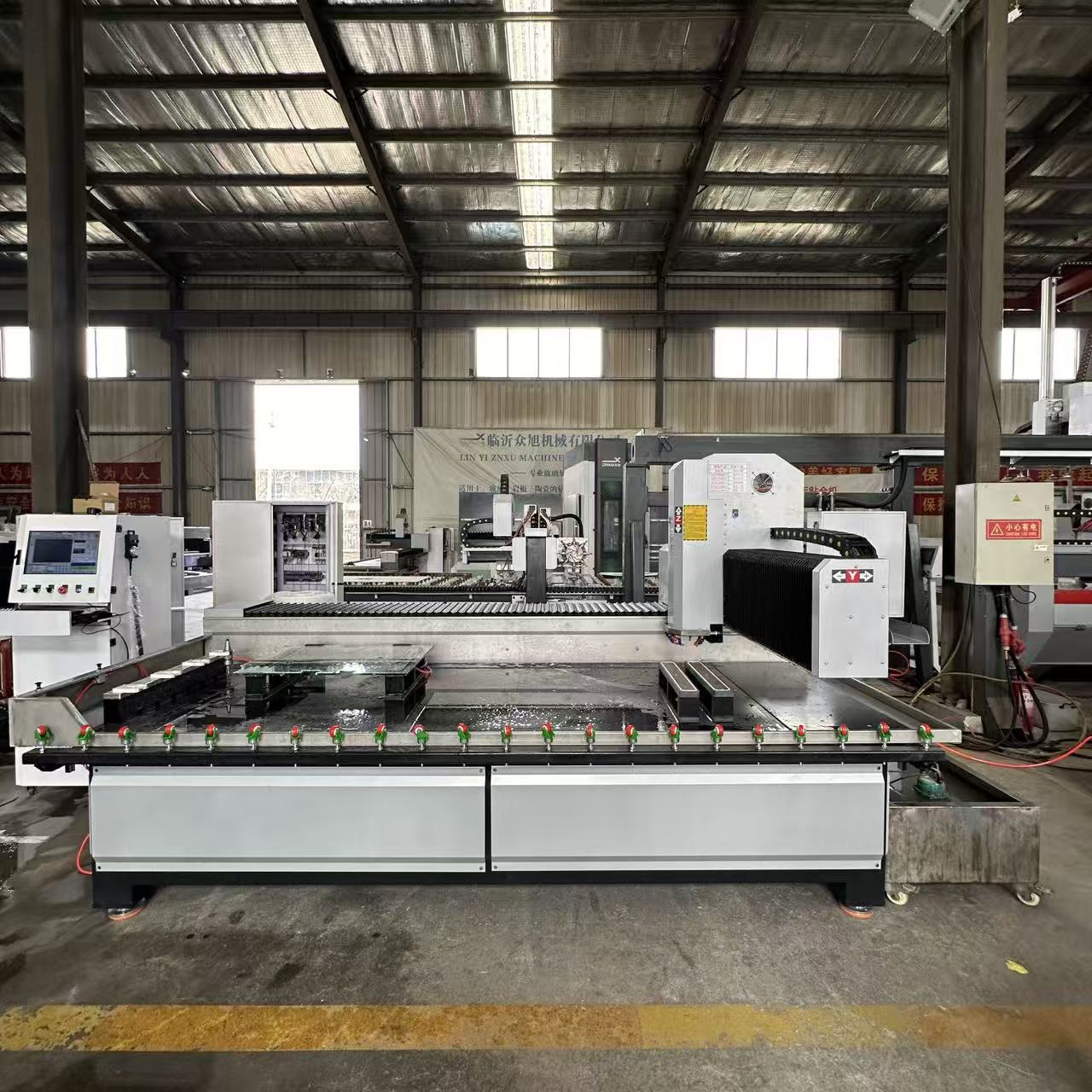
Standard soda-lime glass used in facades, partitions, and doors requires specific processing parameters. Spindle speeds typically run between 8,000 and 12,000 RPM depending on the tool diameter. Feed rates must balance speed with edge quality. Pushing too fast causes micro-fractures. Milling must occur before the tempering process. Machining tempered glass will cause catastrophic shattering. The internal stresses of tempered glass release violently the moment a tool penetrates the compression layer.
Industrial equipment handles hard, brittle materials like quartz, borosilicate, and sapphire glass used in scientific applications. These substrates are significantly harder than standard float glass. They require specialized tooling with different diamond concentrations and bond hardness. You must modify feed rates, often slowing them down by 30% to 50%, to prevent tool burnout and material cracking. Coolant flow must be perfectly targeted at the cutting zone to manage the intense heat generated by these dense materials.
Heavy-duty configurations handle ultra-thick laminated glass, bullet-resistant composites, and natural or engineered stone slabs. A glass and slab milling machine features massive structural rigidity. The gantry and base are often cast iron or heavily ribbed steel to absorb vibrations. High-torque spindles, sometimes rated at 15kW or higher, prevent chatter when milling dense, thick slabs. Chatter leaves a poor edge finish and rapidly destroys expensive diamond tooling. These machines also feature higher Z-axis clearance to accommodate multi-layer laminated blocks.
Manual setups suit one-offs or custom repairs. An operator physically guides the machine or positions the glass for each hole. Automatic CNC systems are essential for batch production. Once you prove out the program, the machine runs identical parts continuously. Dimensional consistency across hundreds of identical parts provides significant value. When supplying glass panels for a large architectural project, every hole must align perfectly with the metal framework. CNC automation guarantees this exact repeatability.
Feature | Manual Glass Milling Machine | Automatic Glass Milling Machine |
|---|---|---|
Tool Changes | Manual wrench swap, slow. | Automatic Tool Changer (ATC), seconds. |
Accuracy | Dependent on operator skill. | CNC controlled, sub-millimeter precision. |
Throughput | Low, high idle time. | High, continuous processing. |
Labor Requirement | Highly skilled artisan. | Trained machine operator/programmer. |
Manual mechanical clamping risks glass breakage. Overtightening a clamp cracks the edge. Clamps also physically block tool access, requiring the operator to stop, unclamp, move the clamp, and restart. Automatic pneumatic vacuum suction pod systems secure the workpiece safely from the bottom. The top surface remains completely clear for machining. Automated zoning allows operators to load or unload workpieces on one side of the bed while the machine processes another section. This pendulum processing drastically reduces machine downtime.
Transitioning to CNC programmers and machine operators reduces reliance on highly skilled manual artisans. Finding operators who can manually mill complex shapes perfectly is difficult and expensive. A CNC machine shifts the skill requirement to the programming stage. Once programmed, a standard operator can load glass and monitor the process. Automatic tool changers (ATC) reduce idle time and manual intervention. The machine selects the right tool, measures its length, and continues cutting without human input.
Manual milling relies on human feel. Pushing a router bit too hard into glass causes thermal shock and edge chipping. Automated feed rates maintain a constant, optimized chip load. The machine never gets tired or rushes a cut. Constant, high-pressure coolant application directly through the spindle or via targeted nozzles keeps the tool and glass cool. This consistency drastically reduces the risk of thermal shock and edge chipping compared to inconsistent manual pressure, saving thousands of dollars in scrapped glass.
Match spindle power and maximum rotational speed to your intended material thickness and tooling diameters. A 7.5kW spindle might be sufficient for 10mm shower doors, but a 15kW spindle is necessary for 30mm laminated architectural glass. Higher RPMs (up to 15,000) are generally better for small diameter router bits to maintain the correct surface speed. Ensure the spindle uses high-precision ceramic bearings to handle the constant water exposure and radial loads.
Evaluate maximum glass thickness processed daily.
Determine the largest tool diameter required for your profiles.
Select a spindle kW rating that provides enough torque at lower RPMs for large profile wheels.
Verify the spindle cooling method (liquid cooling is preferred for continuous glass machining).
High-capacity vacuum pumps secure glass panels without flexing. A liquid ring vacuum pump is often preferred in glass shops because it handles water ingress better than dry rotary vane pumps. Adjustable suction cups or pods must be easy to position. Water-bed tables and vacuum zoning prevent shifting under heavy lateral milling forces. If the glass shifts even one millimeter during a cut, the part is ruined and the tool may break.
Open-architecture CAD/CAM software compatibility is vital. You want to import DXF files directly from your drafting department. Features like tool wear compensation allow the operator to adjust the tool diameter in the software as the diamond wheel wears down, maintaining exact part dimensions. Simulation modes let you preview tool entry and exit paths on the screen to avoid collisions with vacuum pods. User-friendly interfaces ensure rapid job setup and minimal training time.
High-capacity ATCs allow continuous processing without manual tool swaps. A 10-position rotary or linear magazine is usually the minimum for complex edge work. You need slots for roughing routers, finishing routers, multiple core drills, and a sequence of profile and polishing wheels. The ATC mechanism must be shielded from glass swarf and water spray to prevent jamming.
Through-spindle coolant forces water directly down the center of the core drill or router bit. This evacuates the glass plug and swarf immediately, preventing tool burnout. External flood coolant nozzles wash the outer surface. Consistent processing quality relies entirely on clean water. You must integrate a robust filtration system, such as a centrifuge or a settling tank with flocculant, to remove fine glass powder from the coolant before it recirculates.
The high upfront cost of a fully automatic system balances against labor savings, reduced scrap, and the ability to bid on higher-margin, complex jobs. A manual shop cannot competitively bid on a 500-piece commercial railing project. The CNC machine opens up new markets. However, you must calculate the payback period based on actual machine utilization. If the machine sits idle for 6 hours a day, the ROI will stretch out uncomfortably.
Installation involves hidden costs. You need reinforced concrete flooring to support the heavy machinery and maintain level alignment. Three-phase power requirements often necessitate electrical upgrades. Closed-loop water filtration systems take up significant floor space and require plumbing trenches or overhead lines. Do not underestimate the cost of preparing your facility before the machine arrives.
Abrasive glass swarf gets trapped under vacuum suction cups. When the vacuum engages, it grinds that powder into the glass, scratching mirror backs or soft Low-E coatings. Regular bed flushing and maintenance are necessary. Operators must wash down the pods and the machine bed between every cycle. Implementing a strict cleaning protocol is mandatory to maintain surface quality.
CNC programming for glass involves a learning curve. Speeds and feeds for glass are entirely different from wood or metal. Mandatory maintenance routines prevent premature machine failure. You must grease linear guide blocks weekly. Spindle calibration and tool length sensor checks ensure accuracy. Coolant management—cleaning tanks and replacing filters—keeps the spindle bearings alive. Neglecting maintenance on a glass CNC leads to catastrophic repair bills.
An automatic glass milling machine serves as a comprehensive fabrication center that dictates a shop's capacity for complex, high-margin work. It removes the bottlenecks associated with manual drilling and edging. To move forward with an upgrade, follow these steps:
Audit your current production bottlenecks to identify exactly how much time is lost to manual handling and tool changes.
Align procurement choices with primary revenue drivers, selecting high-speed routing configurations for shower doors or heavy-duty torque for thick slab processing.
Request time-studies and sample runs from equipment manufacturers using your specific CAD files and material substrates before purchasing.
Evaluate your facility's electrical and water filtration infrastructure to ensure it can support a high-demand CNC center.
A: Drilling creates fixed-diameter holes using a core drill plunging vertically (axial force). Milling uses a rotating router bit moving laterally along X and Y axes (radial force) to create holes of any size, internal cutouts, and edge profiles.
A: No. All milling, drilling, and cutting must be completed on annealed glass prior to the tempering process. Attempting to mill tempered glass will cause it to shatter instantly.
A: Modern machines use adjustable pneumatic vacuum suction pods raised above the machine bed. This holds the glass securely in place using negative pressure, preventing vibration and contact with abrasive particles on the table surface.
A: Typical tooling includes segmented and continuous diamond router bits, diamond core drills, trapezoidal profile wheels, and specialized polishing wheels, all requiring continuous water cooling.
A: Depending on the Z-axis clearance and spindle torque, heavy-duty slab machines can process laminated glass and stone slabs ranging from 10mm up to 100mm or more, though feed rates must be adjusted accordingly.
A: Lifespan varies heavily based on glass thickness, feed rates, and coolant quality. High-quality diamond routers can process hundreds of linear meters, but require regular dressing to maintain cutting efficiency.
A: Yes, they require CAM (Computer-Aided Manufacturing) software capable of translating 2D or 3D CAD drawings into G-code, specifically optimized for the brittle nature of glass to manage entry/exit speeds and tool paths.


