
Views: 0 Author: Site Editor Publish Time: 2026-09-01 Origin: Site


Frameless glass doors and minimalist enclosures demand highly precise hardware cutouts. Fabricators often face a critical question. Can one machine safely process complex lock boxes and hinge notches without cracking the brittle glass substrate? Absolutely. Specialized milling equipment handles this exact requirement with ease on the fabrication floor.
In this engineering guide, we dive into how these advanced systems operate. We will look at the crucial differences between manual and automated setups. You will also learn what technical specifications matter most when upgrading your production line to handle modern architectural hardware.
Proven Capability: Specialized milling equipment serves as the industry standard for processing complex lock, hinge, and keyhole openings in architectural glass.
Precision Engineering: Modern CNC systems utilize sintered diamond tooling and continuous center-water cooling. This prevents edge chipping and ensures accurate hardware fitment.
Strategic Selection: Choosing between manual and automatic configurations depends entirely on your facility's production volume and custom hardware requirements.
Material Versatility: Advanced slab-capable equipment handles standard float glass alongside thicker materials. This allows for intricate edge routing in heavy-duty applications.
The architectural sector is rapidly shifting away from bulky metal frames. Today, the glass panel itself must bear the structural load of heavy hinges and electronic locking mechanisms. Recent market analyses show a massive surge in demand for smart electronic locks in both residential and commercial spaces. These smart locks require intricate, multi-stepped cutouts with micrometer-level tolerances.
Traditional manual routing simply cannot keep pace with these rigorous standards. Consequently, fabricators are migrating toward CNC-driven automation. This technological shift ensures seamless hardware integration. It also drastically reduces the scrap rate associated with manual handling errors during the fabrication process.
A glass milling machine is a specialized industrial workhorse. It removes material from a glass sheet using high-speed rotary cutters. Standard drill presses merely punch circular holes. Milling systems, however, glide laterally across the X and Y axes. This multi-directional movement allows the spindle to carve out the complex geometric shapes required by modern architectural hardware.
Hinge and lock openings present unique fabrication challenges. Glass is highly brittle. It is exceptionally susceptible to micro-fractures during machining. Hardware components like patch fittings and floor closers often demand U-shaped notches or precise countersunk holes. The mounting screws must sit perfectly flush. Processing these intricate shapes manually with handheld tools frequently leads to uneven edges. These stress concentrations usually result in panel breakage inside the tempering furnace.
Mechanical milling solves this through a calculated approach. The machine first drills a pilot hole to establish a safe entry point. A diamond-impregnated router bit then enters the void. The spindle moves along a programmed tool path. It grinds away the glass laterally to expand and shape the cutout to the exact dimensions of the hinge template. This controlled material removal minimizes mechanical stress.
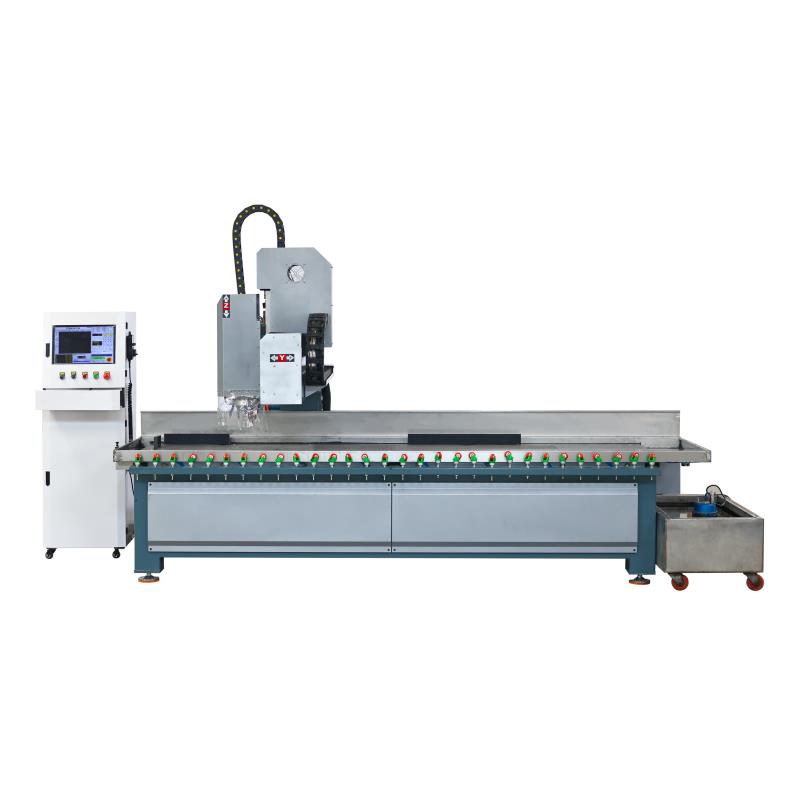
Automation is a fundamental necessity for high-volume processors. It maintains tight tolerances and high yield rates. An automatic glass milling machine relies on advanced computer numerical control systems. These CNC systems execute complex internal cutouts with flawless repeatability.
The core of automated cutout processing lies in precise CNC interpolation. An operator inputs a specific hardware template into the interface. The software translates this geometry into precise machine coordinates. By coordinating the movement of multiple axes simultaneously, the milling cutter traces smooth arcs and sharp corners. Fabricators thereby eliminate the dimensional inconsistencies associated with manual routing.
Processing complex hardware openings rarely requires just one tool. A standard lock box might require a core drill for the pilot hole, a roughing router for bulk material removal, and a chamfering wheel to bevel the sharp edges. Advanced machines handle these transitions seamlessly. A motorized tool magazine drops the worn bit and snaps a fresh finishing router into the collet in seconds. This eliminates human calibration errors and slashes cycle times.
One of the most critical challenges is blowout at the exit point. Advanced automatic machines address this through double-head architectures. Two opposing spindles work together. The bottom tool drills halfway through the thickness. The top spindle immediately follows to complete the bore. Meeting in the middle guarantees a clean edge on both surfaces.
Selecting the right equipment requires a careful analysis of your production demands. Both systems offer distinct operational advantages. Let us break down the specifications to help you make an informed decision.
Feature | Manual Milling Machine | Automatic CNC Center |
|---|---|---|
Tool Changing | Manual wrench operation | Motorized ATC magazine |
Spindle Speed | Standard RPM | High-frequency up to 12,000 RPM |
Production Speed | Moderate | Extremely fast |
Precision Level | Operator dependent | Micrometer-level repeatability |
Ideal Application | Custom shower doors, bespoke projects | High-volume commercial partitions |
A manual glass milling machine requires the operator to physically switch the tooling using wrenches. While less technologically complex, these machines remain highly relevant for bespoke projects. The primary advantage is a significantly lower initial capital investment. They are highly adaptable for one-off projects where programming a complex CNC interface might take longer than the actual milling process. However, manual tool changes add significant minutes to the overall cycle time per panel.
In contrast, automatic variants are engineered for continuous production environments. They offer impeccable repeatability. The thousandth lock hole will be exactly as precise as the first. Featuring high-frequency electro-spindles reaching 12,000 RPM, they operate at much higher speeds. This drastically reduces labor costs and handles multi-step shapes without manual pausing.
Interior design trends are shifting toward heavier materials. Fabricators frequently process thick glass slabs, quartz, and sintered stone. A glass and slab milling machine is structurally engineered to manage these increased physical demands.
Standard machines are optimized for thicknesses ranging from 4mm to 19mm. A slab-capable machine features a heavily reinforced steel frame and high-torque spindles. This structural rigidity prevents the micro-vibrations that naturally occur when routing through dense materials exceeding 19mm.
Thicker slabs inevitably require heavy-duty hardware. Commercial floor closers and structural spider fittings necessitate deeper milling and complex countersinking. Slab milling systems utilize specialized elongated diamond routers. These tools maintain straight perpendicular cuts through thick cross-sections without deflecting under lateral pressure.
Glass is an amorphous solid with high hardness but extremely low tensile strength. It does not deform under cutting pressure. It simply fractures. Modern machinery overcomes these physical limitations through specific engineering solutions.
As a tool exits the glass, the lack of underlying support causes the brittle surface to chip outward. Stress concentrations at these micro-fractures will cause the glass to shatter during tempering. Advanced CNC software automatically applies chamfering tools to bevel the edges immediately after routing. This grinds away micro-chips and leaves a structurally sound profile.
Glass contains highly abrasive silica. Standard carbide tools dull instantly. Furthermore, if a tool moves too fast, it will bite into the glass rather than grinding it. Industrial operations utilize diamond-impregnated sintered bits. Machine control systems monitor spindle load and precisely regulate the feed rate to maintain a safe chip load.
The friction from diamond grinding generates severe localized heat. Glass is a poor thermal conductor. This rapid heating causes uneven expansion and instant thermal shock. Continuous targeted cooling is mandatory. Professional equipment utilizes through-spindle center-water cooling. High-pressure coolant is pumped directly through the hollow center of the bit to flush away abrasive swarf.
High-speed lateral milling exerts significant horizontal force. If the panel chatters even a fraction of a millimeter, the cutout will be misaligned. Machines employ industrial-grade vacuum suction cup arrays. Positioned dynamically across the machine bed, these high-capacity pods create a massive downward holding force.
Understanding specific end-products clarifies why specialized equipment is necessary on your floor.
These doors typically utilize ultra-clear glass framed by a very thin extrusion. Concealed hinges require precise small-diameter blind holes. Because the glass is thin, excessive vibration causes immediate cracking. Automated milling solutions ensure every hinge pocket is identical for rapid assembly.
Utilizing 8mm to 12mm tempered safety glass in wet environments means hardware must grip with absolute security. Shower hinges usually require complex mouse-ear notches and countersunk holes for flush screw mounting. A standard drill press cannot create this notch. It requires full X and Y-axis interpolation.
Floor-to-ceiling glass partitions use heavy panels requiring robust hardware. Fabricators process large rectangular cutouts for heavy-duty patch fittings and internal pockets for electronic strike locks. CNC milling allows fabricators to process these large cutouts with absolute dimensional stability.
A: Yes. By utilizing a specialized diamond countersinking tool after the initial through-hole is drilled, both manual and automatic CNC machines can create perfect countersunk profiles. This is strictly required for the flush-mount screws commonly used in premium shower hinges and architectural hardware.
A: On a modern automatic CNC milling center equipped with an Automatic Tool Changer, a standard rectangular lock cutout can be completed in just a few minutes. This rapid cycle includes initial drilling, lateral shape milling, and final edge chamfering. Manual machines will take considerably longer.
A: Glass drilling is a vertical Z-axis operation that creates simple round holes using a hollow core bit. Conversely, glass milling utilizes a router bit that moves laterally across the X and Y axes. This lateral interpolation allows the machine to carve out complex non-circular shapes like rectangles and U-notches.
A: Always after. Glass must be cut to size, drilled, milled, edged, and completely fabricated before it enters the tempering furnace. The tempering process puts the outer surfaces into a state of extreme compression. Attempting to drill or mill the material after it has been tempered will cause the entire panel to shatter instantly.
A: For optimal edge quality and tool life, a high-frequency spindle operating between 10,000 and 12,000 RPM is recommended. This allows the diamond router to take smaller and faster cuts. It significantly reduces mechanical stress on the brittle glass substrate.
A: Yes. Processing laminated glass requires precise feed rate control and specialized tooling. This prevents tearing the PVB or SGP interlayer while maintaining a clean cut on both exterior glass surfaces.
A reliable CNC center is an essential asset for processing modern lock and hinge openings profitably. By combining precise interpolation, diamond tooling, and robust water cooling, these systems effortlessly handle brittle substrates without compromising structural integrity.
Carefully assess your daily production volume. Choose a manual model for bespoke work, or invest in an automated CNC center for high-speed output. For heavy architectural projects, ensure you select slab-capable routing equipment. Visit ZNXU Glass Machine to explore our full range of professional glass processing equipment and find the perfect configuration for your fabrication floor.


