
Views: 0 Author: Site Editor Publish Time: 2026-09-07 Origin: Site


Machining raw glass is notoriously unforgiving. A single microscopic fracture during fabrication can shatter an entire expensive sheet, bringing production to an immediate halt. Safely creating hardware cutouts, complex notches, and precise mounting holes requires highly specialized industrial equipment. Engineers and floor managers understand that standard cutting tools simply will not work on a brittle molecular structure. In this technical breakdown, we examine exactly how a glass drilling and milling machine solves these fabrication hurdles to transform fragile panels into functional architectural components.
Industrial Versatility: Modern machining centers execute precise holes, edge notches, and complex internal cutouts required for architectural facades, frameless furniture, and automotive glass.
Zero-Tolerance Applications: Flawless hinge and handle cutouts are mandatory for frameless shower enclosures. Hardware must align perfectly to avoid stressing the glass after tempering.
Automated Efficiency: Computer Numerical Control technology eliminates human tactile errors. This drastically increases throughput speed while dropping expensive material spoilage to near zero.
Combined Operations: Today's equipment merges vertical plunging and horizontal routing into a single clamped setup, slashing material handling times and saving valuable factory floor space.
Unlike metalworking or woodworking equipment that relies on shearing forces to slice through material, glass machinery operates on an entirely different physical principle. A glass machining center is an industrial fabrication platform engineered specifically to grind away flat glass safely. These heavy-duty systems provide massive structural stability, pinpoint servo-driven spindle control, and aggressive temperature regulation to prevent thermal shock.
To understand the process, you must look at the tooling interface. These machines do not actually cut the material. Instead, they use diamond-coated abrasive bits operating at high RPMs to grind the glass into a fine powder known as swarf. High-speed grinding generates intense localized friction. A continuous, heavy flow of coolant water is an absolute physics requirement. The fluid prevents thermal micro-fractures and continuously flushes away the abrasive dust to keep the cutting path completely clear.
While frequently housed within the exact same automated unit, these represent two distinct mechanical operations requiring different tool profiles.
Feature | Vertical Drilling | Horizontal Milling |
|---|---|---|
Tooling Used | Cylindrical diamond core bit | Specialized diamond routing bit |
Axis Movement | Z-axis only | Z-axis plunge, followed by X and Y lateral movement |
Primary Purpose | Boring perfectly round holes for standoffs and screws | Carving complex internal shapes, countersinks, and edge notches |
Spindle Configuration | Requires opposing top and bottom spindles to prevent blowout | Typically utilizes a single high-torque top spindle |
Modern factory floors rely on combined equipment. Performing both operations without unclamping the glass means operators avoid manually moving heavy, slippery sheets between isolated workstations. This single-setup approach is the foundation of high-yield fabrication.
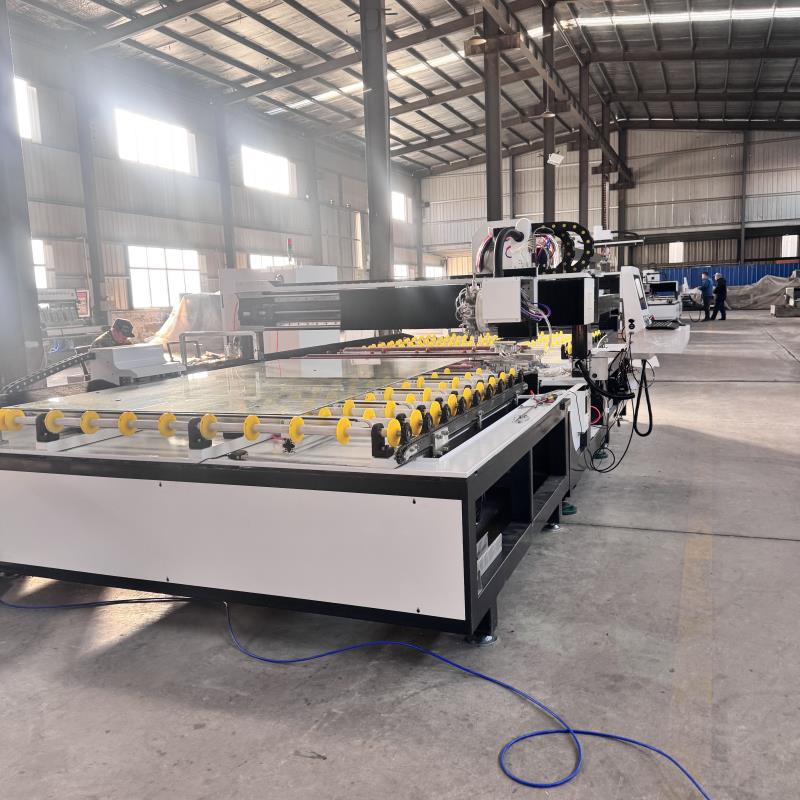
Almost any piece of commercial or residential glass requiring hardware attachment must pass through a machining center before reaching the tempering furnace.
The high-volume production of frameless shower doors relies entirely on exact dimensional measurements. Heavy brass hinges and structural support bars must fit flawlessly. Utilizing a specialized shower door glass drilling machine is critical for maintaining these tight tolerances.
Precision here is non-negotiable. If a hinge cutout is misaligned by just two millimeters, the hardware will bind. The entire pane instantly becomes expensive scrap. Furthermore, all milling must occur on raw float glass. Once a panel undergoes thermal tempering, the internal stresses are permanently locked. Any attempt to drill tempered glass will cause a catastrophic, violent shatter. Every cutout must be executed flawlessly on the first pass.
Commercial construction relies heavily on structural glass for building facades, floating staircases, and frameless balustrades. These demanding applications require thick, heavy-duty panels up to 19mm or 25mm thick. Fabricators must bore large-diameter holes to accommodate heavy-duty spider fittings and mechanical anchors. An industrial center provides the massive spindle torque and vibration-free bed stability required to grind through thick laminates without causing internal delamination or surface chipping.
Transitioning from lever-operated drill presses to fully automated systems has revolutionized factory output. Understanding the underlying mechanics clarifies why these machines deliver such high ROI.
CNC technology replaces manual hand-wheels with absolute-encoded servomotors. The workflow starts with CAD/CAM software. An engineer digitally designs the panel, mapping the exact coordinates of all cutouts. The software translates this blueprint into machine code. The onboard computer then dictates exact spindle feed rates, plunge depths, and rotational speeds, completely removing human guesswork.
Pushing a drill bit all the way through a brittle material from one side guarantees a blown-out exit hole. Automated machines elegantly solve this physics problem using opposing top and bottom spindles.
The sequence is precise. First, the bottom spindle rises and drills slightly past the halfway point of the glass thickness. The bottom spindle then retracts. Immediately, the top spindle descends along the exact same Z-axis to complete the hole. Meeting perfectly in the middle ensures both the entry and exit surfaces remain incredibly smooth and free of flaking.
A single architectural panel frequently requires multiple hole sizes and complex routed shapes. Advanced equipment features an Automated Tool Changer. When the program dictates a shift from a 10mm drill to a 12mm router bit, the spindle travels to a rotating magazine, swaps the tool pneumatically, and resumes cutting in seconds. This requires zero operator intervention.
The global architectural sector is experiencing a massive push toward minimalist, frameless aesthetics. Developers demand jumbo-sized glass installations with unobstructed views. Consequently, hardware tolerances have become incredibly tight. Manual fabrication methods simply cannot keep pace with these modern quality demands.
Simultaneously, the manufacturing sector faces a severe shortage of skilled manual laborers capable of drilling glass by hand without breaking it. To combat rising material costs and labor gaps, processing facilities are aggressively adopting fully automated CNC lines. Modern equipment now integrates directly with factory ERP software, allowing for seamless batch processing. This shift guarantees repeatable microscopic precision and allows businesses to scale output exponentially with a leaner workforce.
When evaluating capital equipment for a production line, specific technical specifications directly dictate the machine's longevity and edge quality.
Vibration is the ultimate enemy of glass processing. It causes micro-fractures, poor edge finishes, and premature diamond tool wear. High-quality machines utilize heavy-duty cast iron or thick welded steel frames. A rigid structure, such as that found in a premium CNC glass drilling and milling machine, absorbs operational vibrations. This ensures the spindles remain perfectly aligned even during aggressive routing at 12,000 RPM.
External flood coolant nozzles are standard, but they are not enough for high-speed production. Premium systems utilize internal through-spindle cooling. High-pressure pumps force water directly down through the hollow center of the diamond core bit. This targeted flow actively flushes abrasive swarf out of the hole interior, preventing the bit from binding or glazing over.
Selecting the right machinery requires matching technical specifications to your actual production metrics. Avoid under-specifying your power requirements.
Evaluate Daily Throughput: If your facility processes a low volume of bespoke pieces, a semi-automatic vertical drill may suffice. However, if you are processing 50 to 100 shower doors daily, a fully automated CNC center with a minimum 5-tool magazine is mandatory to handle the continuous duty cycle without bottlenecking.
Match Spindle Power to Glass Thickness: Do not attempt to mill 19mm architectural glass with an entry-level motor. For heavy-duty structural glass, specify machines equipped with at least 7.5 kW to 9 kW spindle motors. This provides the necessary torque to maintain constant RPMs under heavy lateral loads.
Demand Intuitive Software: The machine is only as fast as its programmer. Prioritize equipment featuring touchscreen Human-Machine Interfaces with pre-loaded parametric libraries. Operators should be able to select a standard hinge shape, input dimensions, and hit start without writing custom code.
Glass processing is highly abrasive. Establishing a strict preventative maintenance protocol is the only way to protect your capital investment.
Spindle Concentricity Calibration: Flawless holes rely on the perfect alignment of the top and bottom drills. Standard operational vibration can cause microscopic deviations over time. Maintenance teams must perform routine calibration checks using dial indicators to ensure both spindles remain within strict factory tolerances.
Coolant Quality Management: Water saturated with glass dust transforms into a highly abrasive slurry. This mixture will destroy waterproof seals and clog internal cooling lines. Facilities must clean settling tanks regularly and utilize centrifuge filtration systems to separate swarf from clean coolant.
Proactive Tool Replacement: Operating with dull diamond bits forces the spindle motors to draw excessive amperage. Operators must recognize the signs of tool wear, including high-pitched grinding noises, increased motor load on the control screen, and visible micro-chipping around the hole perimeter. Replace bits proactively to protect spindle bearings.
Investing in a dedicated glass drilling and milling machine is a strategic necessity for any modern fabrication facility. It is the critical engine behind high-margin products like structural facades and frameless shower enclosures. By replacing manual guesswork with automated CNC precision, factory managers can drastically increase production speeds, eliminate costly material blowouts, and solve skilled labor shortages. To elevate your floor's capabilities and find the exact specifications your production line demands, explore the comprehensive catalog of automated solutions at ZNXU Glass Machine today.
The core difference lies in the tool kinematics. Drilling plunges a cylindrical diamond bit vertically into the glass to bore perfectly round holes for screws or standoffs. Milling utilizes a routing bit that plunges into the glass and moves horizontally along the X and Y axes. This lateral movement carves out complex internal shapes and edge notches. Modern CNC centers execute both processes seamlessly.
No. It is physically impossible to drill or mill tempered glass. The thermal tempering process puts the outer surfaces into high compression and the interior into high tension. Penetrating the compressed surface layer instantly releases this stored energy, shattering the entire pane into thousands of granular pieces. All fabrication must happen on raw annealed glass before tempering.
Capacity depends on structural rigidity and spindle power. Standard industrial machines easily process glass from 3mm up to 19mm thick. Heavy-duty models engineered for specialized architectural applications can handle 25mm or thicker laminates. Processing thicker glass simply requires optimized feed rates and high-pressure through-spindle cooling.
Optimal RPM depends entirely on the diameter of the drill bit and the thickness of the glass. Generally, smaller diameter bits require much higher speeds, often between 4,000 and 6,000 RPM, to grind efficiently. Larger diameter core bits require slower speeds, typically between 1,500 and 3,000 RPM, to prevent excessive heat buildup. Always consult the tooling manufacturer's feed and speed charts.
Preventing chipping requires three critical elements. First, use a dual-spindle machine that drills from both the top and bottom, meeting in the middle to prevent exit blowout. Second, ensure a massive volume of water coolant is directed exactly at the cutting interface to prevent thermal shock. Finally, maintain perfectly sharp diamond bits and use a slow, controlled plunge feed rate via CNC servo motors.


