
Views: 0 Author: Site Editor Publish Time: 2026-07-31 Origin: Site


Transitioning from custom, low-volume glass fabrication to high-capacity batch production exposes the operational limits of manual and semi-automatic edge processing. In high-volume architectural, mirror, or furniture glass manufacturing, achieving exact bevel consistency across hundreds of panels while controlling labor costs and minimizing material waste is the primary operational bottleneck. You need equipment that handles continuous feeding without constant manual recalibration. Relying on operator feel for edge grinding simply does not scale when you have pallets of glass waiting for processing.
This guide evaluates whether upgrading to an automatic glass beveling machine is a financially and operationally sound decision for batch production environments. We examine machine configurations, throughput capabilities, and implementation risks. You will learn how automated systems impact yield, maintenance requirements, and overall facility workflow, allowing you to make an informed equipment upgrade decision based on hard production metrics rather than guesswork.
Automation Drives Consistency: Programmable Logic Controllers (PLCs) in automatic machines eliminate human error in angle, depth, and thickness adjustments, ensuring uniformity across large batch runs.
Configuration Dictates Workflow: Selecting between a horizontal glass beveling machine and a vertical glass beveling machine depends heavily on facility footprint, glass size, and existing line integration.
CapEx vs. Yield: While initial capital expenditure is high, the reduction in rework, scrap, and manual labor hours typically accelerates the ROI for facilities processing bulk architectural orders.
Maintenance is Critical: High-volume production accelerates wear on diamond and resin wheels; predictable maintenance schedules and robust water filtration are mandatory for sustained uptime.
Establishing baseline requirements for processing speed is the first step in evaluating any new machinery for the shop floor. You must measure throughput in meters per minute without compromising the optical clarity or dimensional accuracy of the bevel. High throughput means nothing if the final product fails quality control due to burn marks, uneven edges, or chipping. You need a system that balances rapid glass feeding with precise material removal. In a high-volume setting, the machine must run continuously for hours, maintaining the exact same edge profile on the first sheet as it does on the five-hundredth sheet.
Transitioning to automated systems impacts labor reduction heavily. You move from operator-dependent machines to set-and-forget systems. This shift reallocates your workforce. Instead of having three workers manually pushing glass through a semi-automatic grinder, one operator can monitor the automated line, check PLC parameters, and perform quality control inspections. Defining acceptable waste margins in batch production shows how automated consistency directly impacts the bottom line. When you eliminate the human variable from the grinding pressure, scrap rates plummet.
Automatic machines feature continuous feeding mechanisms driven by heavy-duty conveyors. Semi-automatic units require manual handling, repositioning, and multi-pass grinding. Continuous feeding eliminates the start-and-stop delays inherent in manual operations. When an operator has to physically load, guide, and unload a single piece of glass multiple times to achieve the desired bevel depth, the cycle time per piece skyrockets. Automatic systems pull the glass through a series of spindles in one fluid motion.
Automatic machinery reduces total processing time per sheet significantly. It executes rough grinding, fine grinding, and polishing in a single, uninterrupted pass. You transition from highly skilled manual operators who rely on physical grinding feedback to machine operators who focus on digital parameters. The skill set changes from manual dexterity to technical oversight.
Operational Metric | Semi-Automatic Beveling | Automatic Beveling |
|---|---|---|
Feeding Mechanism | Manual push and guide | Motorized continuous conveyor |
Passes Required | Multiple passes for deep bevels | Single pass execution |
Operator Skill Level | High manual dexterity required | Basic PLC operation and QC |
Batch Consistency | Variable based on operator fatigue | Highly uniform across all panels |
Throughput Rate | Low to medium | High (up to 5+ meters per minute) |
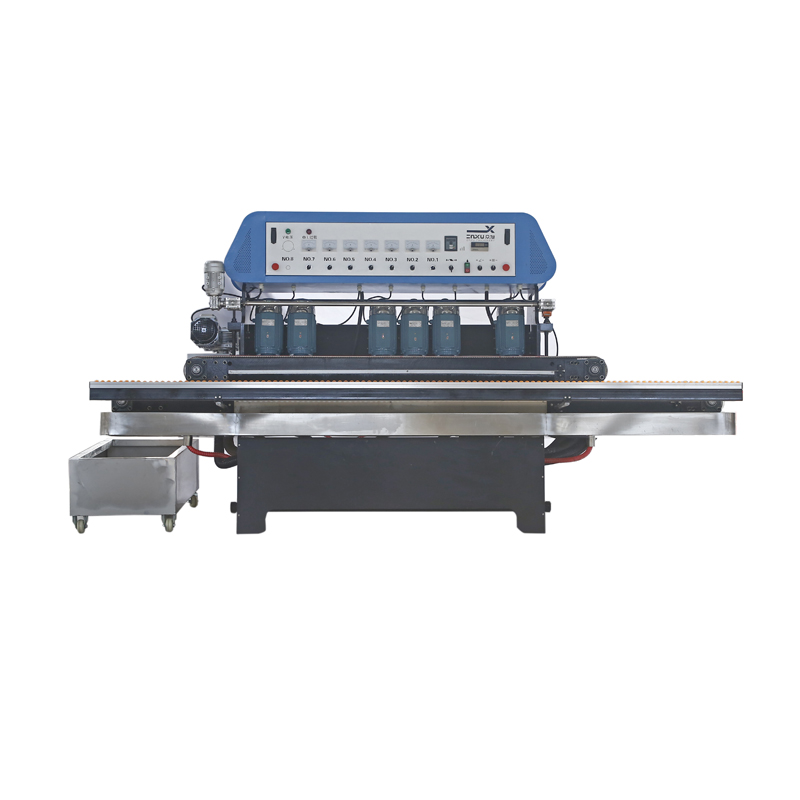
Automated track systems and pneumatic pressure controls maintain uniform edge removal. They handle varying lengths of straight-line glass seamlessly. The pressure remains constant across the entire glass edge, preventing the common issue of "snipe" or over-grinding at the leading and trailing corners of the glass panel. Heavy-duty backing plates and precision-milled tracks keep the glass perfectly vertical or horizontal as it passes the grinding wheels.
Automated thickness detection prevents edge chipping. It ensures even bevel widths during continuous feeding. Sensors adjust the grinding wheels instantly if slight thickness variations occur in the raw glass batch. Float glass can have minor thickness tolerances from the factory. An automated machine compensates for these micro-variations without requiring the operator to stop the line and manually adjust the spindle depth.
Modern PLCs allow operators to save specific bevel angles and widths. You can store glass thickness parameters as recallable recipes for recurring batch orders. This eliminates manual wheel calibration between shifts. When the morning shift takes over from the night shift, they simply load the recipe for the current production run. The machine automatically adjusts the spindle angles and conveyor width to match the saved parameters.
Recipe management drastically reduces setup time. Switching from heavy architectural glass to thinner decorative mirrors takes seconds. You simply select the pre-programmed recipe on the touchscreen. The servo motors drive the spindles into the exact position required. This rapid changeover capability is what makes automated machines viable for facilities that handle multiple product lines in a single day.
You must ensure the PLC and mechanical guides handle diverse flat glass sizes. Define the minimum and maximum dimensions acceptable for continuous runs. Avoid manual mechanical reconfiguration whenever possible. If your facility frequently processes small glass tiles alongside large architectural panels, verify that the conveyor pads can grip the smallest pieces securely without them slipping during the high-torque grinding phase.
Straight-line configurations are the industry standard for high-speed runs. They process square and rectangular panels efficiently. The linear conveyor design allows continuous glass loading. As soon as the trailing edge of one panel clears the input sensor, the operator can load the next panel. This creates a continuous ribbon of glass moving through the machine, maximizing spindle utilization and output.
CNC-controlled shaped beveling machines exhibit lower throughput. They process one complex shape at a time. The machine must trace the perimeter of the glass, which takes significantly longer than a straight-line pass. Use straight-line machines for bulk rectangular orders to maximize daily output. Reserve your CNC shaped bevelers for custom, high-margin architectural pieces like oval mirrors or custom tabletops.
A horizontal glass beveling machine is ideal for heavy, oversized architectural glass. It integrates well into a continuous, flat-line production flow. The flat orientation provides superior stability for wide bevels on thick glass. When you are beveling 19mm glass for a heavy tabletop, the horizontal orientation prevents the glass from flexing or bowing under its own weight.
Loading exceptionally heavy panels is easier horizontally. You can use overhead cranes or vacuum lifters safely to drop the glass directly onto the input conveyor. However, this configuration requires a massive facility footprint. You need clearance on all sides for loading and unloading equipment. Water pooling can also be an issue without optimal drainage design. Horizontal machines require robust water pumps to clear the coolant from the flat glass surface before it exits the machine.
A vertical glass beveling machine suits facilities with strict space constraints. It integrates directly with vertical washing and insulating glass lines. The vertical stance offers a significantly smaller footprint, allowing you to place the machine closer to walls or other equipment. This is often the preferred choice for mirror manufacturers and standard window fabricators.
Natural water runoff improves wheel life and cooling efficiency. Gravity pulls the coolant and glass dust straight down into the collection trough. This keeps the grinding area cleaner and prevents sludge buildup on the conveyor tracks. Manual loading for standard-sized panels is highly ergonomic. Operators can slide the glass onto the input rack without bending over. Extremely long or heavy glass sheets may require specialized support racks to prevent bowing, as the top edge of the glass is unsupported during the vertical pass.
Feature | Horizontal Configuration | Vertical Configuration |
|---|---|---|
Floor Space Requirement | Large footprint, requires wide clearance | Compact, space-saving design |
Glass Handling | Ideal for oversized, heavy panels via crane | Ergonomic manual loading for standard sizes |
Water Drainage | Requires engineered drainage and blowers | Natural gravity runoff into troughs |
Line Integration | Flat-line tempering and laminating | Vertical washing and IG units |
Glass Stability | Maximum stability for thick, heavy glass | May require top supports for long sheets |
The number of grinding motors dictates processing speed and finish quality. High-quality polish typically requires 9 to 14 spindles. More spindles distribute the grinding workload effectively. If you try to achieve a wide bevel with only 4 or 5 spindles, each wheel has to remove too much material. This leads to excessive wheel wear, glass burning, and a cloudy finish.
The sequence matters for a continuous automated line. Rough grinding uses coarse diamond wheels to remove the bulk of the material quickly. Fine grinding relies on resin wheels to smooth out the deep scratches left by the diamond grit. Final polishing utilizes felt wheels combined with a cerium oxide slurry to achieve a flawless, optically clear finish. Each spindle must be calibrated to remove a specific fraction of a millimeter.
More spindles allow faster conveyor speeds. Because each wheel removes less material per pass, the glass can travel through the machine at a higher velocity. This reduces wheel wear and prevents glass burning at high speeds. Investing in a 14-spindle machine over a 9-spindle machine directly increases your daily throughput capacity.
Input and output conveyors must withstand continuous heavy loads. The main drive track requires exceptional durability. Heavy-duty, wear-resistant timing belts prevent glass slippage. If the glass slips even a fraction of an inch while passing over the grinding wheels, the bevel will be ruined. The grip pads on the conveyor must be inspected regularly and replaced when they lose their elasticity.
Precision bearings ensure smooth glass travel. Any vibration in the track transfers directly to the bevel edge, causing chatter marks. Robust conveyors are non-negotiable for high-speed batch runs. The steel frame supporting the conveyor must be rigid enough to absorb the vibration generated by a dozen heavy-duty spindle motors running simultaneously.
Batch production accelerates wheel wear significantly. You must forecast the replacement rate of diamond and resin wheels accurately. Track the linear meters processed per wheel. Do not wait for the bevel quality to degrade before changing wheels. Establish a preventative maintenance schedule based on actual production data.
Monitor wheel degradation closely. Sudden drops in bevel quality indicate worn resin wheels or clogged diamond wheels. Implement a predictive replacement schedule to prevent unexpected downtime. Keep a robust inventory of replacement wheels, cerium oxide powder, and conveyor pads on hand. Waiting for consumables to ship from an overseas supplier will halt your production line.
Multi-spindle machines draw substantial electrical loads. Assess your facility power capacity before installation. A 14-spindle machine requires a dedicated, high-amperage circuit. You also need stable, clean compressed air for pneumatic components. The pneumatic cylinders control the pressure of the polishing wheels. If your air pressure fluctuates, your polish quality will be inconsistent.
A robust water filtration system is mandatory. Closed-loop circulation prevents glass dust from destroying machine bearings. Clean water ensures optimal wheel cooling and extends consumable life. Pumping dirty, abrasive water back onto the grinding wheels will wear out the wheels prematurely and scratch the glass. Invest in a centrifuge or a multi-stage settling tank system to keep your coolant clean.
Navigate relationships with international wholesale suppliers carefully. Request Factory Acceptance Testing (FAT) before final shipping. Send your specific material samples to the manufacturer for verification. Do not rely on generic test videos. You need to see the machine processing your exact glass thickness and bevel profile.
Evaluate manufacturer support structures thoroughly. Check spare parts availability for spindles, timing belts, and waterproof bearings. Remote diagnostic capabilities are highly valuable for rapid troubleshooting. Ensure the manufacturer can connect to the machine's PLC remotely to diagnose software faults or sensor errors.
Modeling financial returns requires analyzing daily output increases. Calculate the exact labor headcount reduction per shift. Automated systems allow one operator to manage multiple lines. If you currently employ four people to run semi-automatic bevelers, an automated line might reduce that requirement to one or two people. Reallocate the remaining staff to assembly or shipping departments.
Minimized glass breakage improves your yield instantly. Consistent automated handling reduces scrap rates. The reduction in rework accelerates your break-even point significantly. When every piece of glass comes off the line with a perfect bevel, you eliminate the time and material wasted on recutting and regrinding rejected panels.
Audit your facility floor space to determine if a vertical or horizontal configuration fits your existing workflow and material handling equipment.
Identify your heaviest standard glass size to specify the required conveyor load capacity and structural rigidity of the machine frame.
Request precise cycle-time estimates from manufacturers based on your exact glass dimensions and required bevel width.
Demand a live test run using your actual glass materials before finalizing any equipment order to verify optical clarity.
Verify the supplier maintains a robust local service infrastructure for spare parts, consumable wheels, and technical support.
A: Production capacity depends on spindle count and glass thickness. Most industrial automatic machines process between 1 to 5 meters of glass per minute. Higher spindle counts allow faster conveyor speeds while maintaining a polished finish.
A: Vertical machines benefit from gravity, allowing water and glass dust to run off naturally. This keeps bearings and tracks cleaner. Horizontal machines require more frequent cleaning to prevent water pooling and sludge buildup on the drive tracks.
A: No. While PLCs allow quick recipe changes, you must group glass by thickness for continuous batch runs. Feeding different thicknesses simultaneously will cause uneven grinding and potential glass breakage.
A: Minimum sizes are typically around 100mm x 100mm, limited by the conveyor pad grip. Maximum sizes depend entirely on the input/output rack extensions, often exceeding 3000mm for architectural glass.
A: Diamond wheels can process tens of thousands of linear meters. Resin wheels wear much faster and require frequent adjustment or replacement. Lifespan varies heavily based on glass thickness and bevel width.
A: Yes. Continuous batch production generates massive amounts of glass dust. A dedicated closed-loop filtration system prevents sludge from destroying the machine's water pumps and grinding spindles.


